God’s Appointed Times
PREFACE —-Reading Leviticus 23 With Fresh Eyes
The twenty third chapter of Leviticus is often approached as a list of ancient observances, but the chapter is doing more than marking dates. It offers a framework for understanding how God shapes a people through a sequence of observances. These observances are called “appointed times.”
“These are the feasts of the Lord, holy convocations which you shall proclaim at their appointed times.” (Leviticus 23:4)
These appointed times are not about earning anything from God. They are about learning to live as those who have been rescued from a sinful world.
The New Testament does not discard these appointed times. Instead, it shows how they point forward—to Christ, to the Holy Spirit, and to the future God is planning for all mankind.
Chapter 1 - God Teaches Through Time
Leviticus 23 is often read as a list of ancient holidays, but in reality, it functions more like a road map. It traces how God forms a people, shapes their identity, and anchors them in His story. The appointed times are not random observances. They are patterns that reveal how God is working out His plan of salvation for his human creation.
These appointed times, also known as the Holy Days to modern Christians, are not a second attempt to salvation. God saves first through Jesus Christ, then teaches His people how to live as those who belong to Him.
With this in mind we will now look into the storyline of salvation as God lays it out through His appointed times.
It All Begins with the Sabbath
The Sabbath (Friday sunset to Saturday sunset) is placed inside the wider sequence of appointed times. The placement is important: God forms His people through repeated patterns.
Two principles help keep the chapter clear.
1. The appointed times are not a system of earning salvation. God rescues first, then guides His people as they learn to obey him.
2. Fulfillment does not erase meaning. When Christ fulfills a pattern, He brings its purpose into focus. Let’s take a look at Matthew 5:17:
“Do not think that I came to destroy the Law or the Prophets. I did not come to destroy but to fulfill.”
When Jesus says He did not come to destroy but to fulfill, the Greek wording used in this verse clarifies what many have misunderstood.
The word translated “fulfill” in Matthew 5:17 is the Greek verb:
πληρόω (plēróō)
to fill (as in filling something up)
to make full / bring to full measure
to complete / bring to its intended goal
to carry out fully (especially of words, Scripture, prophecy)
What Does Abolish Mean?
In this context, plēróō is not “abolish” or “discard.” It means Jesus came to bring the Law and the Prophets to their full intended meaning and completion—by obeying them perfectly, confirming what they truly teach, and bringing their prophetic trajectory to its goal.
Not canceling Scripture, but bringing it to its intended fullness
(a) by embodying it (perfect obedience),
(b) by bringing its promises and patterns to completion (prophetic fulfillment), and
(c) by bringing its meaning to full expression.
With that said, Jesus was reminding his followers that:
“The Sabbath was made for man, and not man for the Sabbath. Therefore, the Son of Man is also Lord of the Sabbath.” (Mark 2:26-27)
By stating that the Son of Man is Lord of the Sabbath, he was making clear that he, not the religious authorities, created the Sabbath. Further, he had the authority to provide the guidelines as to how it was to be observed. He did this by what he did on the Sabbath. He did not do away with the Sabbath but demonstrated how to observe it by what he did on that day.
Man with an unclean spirit in synagogue (Mk 1:21–28; Lk 4:31–37)
Peter’s mother-in-law (Mk 1:29–31; Lk 4:38–39; cf. Mt 8:14–15)
Withered hand (Mt 12:9–13; Mk 3:1–6; Lk 6:6–11)
Bent/crippled woman (Lk 13:10–17)
Man with dropsy (Lk 14:1–6)
Paralytic at Bethesda (Jn 5:1–18)
Man born blind (Jn 9:1–14)
Jesus healed on the Sabbath to reestablish something that had been lost. Namely, showing mercy to the sick is NOT outside the command “to keep the Sabbath holy.”
NOTE: the word holy in Hebrew is kadosh, which signifies being set apart. In other words, by demonstrating mercy to the sick was a way to set apart the appointed time.
Of course, it is also incumbent on believers to show mercy and kindness every day, but to do so on the Sabbath had an additional meaning which we will discover later. Jesus restores the Sabbath’s intent. He treats it as a day for mercy and renewal, not restriction. The book of Hebrews expands the theme further, describing Sabbath as a preview of the final rest God promises his people. We will expand on this theme later in this book as well.
Sabbath is the first appointed time, appearing in Genesis before Israel or Sinai. It teaches rest, trust, and identity rooted in God’s work, not human effort (Genesis 2:1–3). It is important to note that the Sabbath was created by God before the establishment of the Covenant He made with Israel.
“Thus, the heavens and the earth, and all the host of them, were finished. And on the seventh day God ended His work which He had done, and He rested on the seventh day from all His work which He had done.” (Genisis 2:1-2)
Later, it would become the covenant sign for ancient Israel. However, as we will see, its core message stays the same: God builds rest into creation, and His people are to live within that gift.
Religious authorities of Jesus’ day had made the Sabbath a burden. Instead of worshiping God on that “appointed time” it had become a time to measure how righteous one was or was not.
Key Themes
Sabbath begins as a creation gift. It is given before it is commanded. (Genesis 2:1-2)
Rest from working. Reminds us of the fact the world does not depend on our constant effort.
Jesus centers Sabbath on mercy. He protects people from burdensome interpretations. (Luke 13:10–17)
Sabbath points forward. Weekly rest anticipates God’s future restoration.
Implications for the Church
Rest becomes a quiet act of trust in a restless culture.
Communities shaped by grace (undeserved and unearned forgiveness) will learn to treat others with gentleness.
Weekly patterns prepare believers to live with hope toward God’s promised rest.
CHAPTER 2 - The Spring Sequence as a Storyline
The spring appointed times—Passover, Unleavened Bread, Firstfruits, and Pentecost—are not isolated observances. Together, they form a narrative arc:
Passover — God redeems through sacrifice
Unleavened Bread — God forms a purified people
Firstfruits /Pentecost— God empowers His people for living and preaching the gospel.
Let Us Keep the Feast
Definition: (Redemption means release by payment—being brought out of bondage by a rescuer who pays the cost. In Exodus it is rescue from slavery; in Christ it is rescue from sin and death by the price of the Lamb.
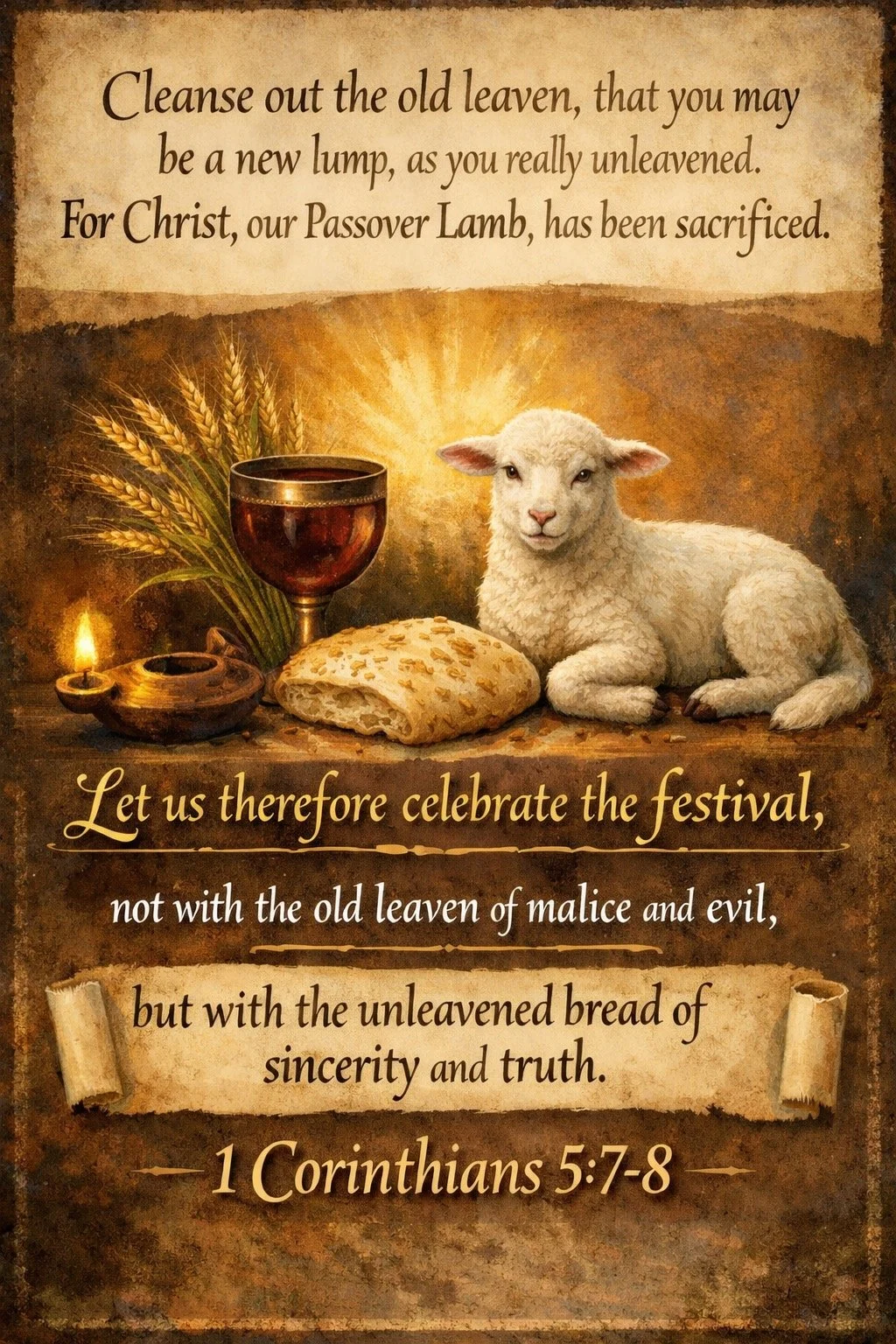
“Therefore, purge out the old leaven that you may be a new lump, since you truly are unleavened. For indeed Christ, our Passover, was sacrificed for us. Therefore, let us keep the feast, not with old leaven, nor with the leaven of malice and wickedness, but with the unleavened bread of sincerity and truth.” (1 Corinthians 5:7–8)
The Apostle Paul begins with a conclusion that surprises many modern readers. In 1 Corinthians, he said Christ is our Passover—and then he says believers should respond to that reality by “keeping the feast,” not as a salvation method, but as a way of life marked by sincerity and truth. Paul made that point again in the book of Romans.
“And so, dear brothers and sisters, I plead with you to give your bodies to God because of all he has done for you. Let them be a living and holy sacrifice—the kind he will find acceptable. This is truly the way to worship him.” (Romans 12:1 NLT)
It should be noted that Paul connects Godly worship with this caveat in mind:
“Don’t copy the behavior and customs of this world but let God transform you into a new person by changing the way you think. Then you will learn to know God’s will for you, which is good and pleasing and perfect.” (Romans 12:2 NLT)
A Christian must be continuously on guard from being reabsorbed into the culture. Here is another (paraphrased) version of the same verse:
“Do not be conformed to this world (this age), [fashioned after and adapted to its external, superficial customs], but be transformed(changed) by the [entire] renewal of your mind [by its new ideals and its new attitude], so that you may prove [for yourselves] what is the good and acceptable and perfect will of God, even the thing which is good and acceptable and perfect [in His sight for you".”(Romans 12:2 AMPC)
The Apostle John was inspired to warn the Church, when he wrote: “And I heard another voice from heaven saying, “Come out of her, my people, lest you share in her sins, and lest you receive of her plagues.” (Revelation 18:4) God’s people are constantly warned not to be a part of this world (age) way of thinking and living.
That tells us something important right up front: Paul treats Passover as a meaningful lens for understanding both the Messiah’s sacrifice and the Christian life that follows.
Passover is the starting point of Israel’s story as a freed people. It centers on a substitute—the lamb whose blood placed on the doorpost of each household for rescue from the “destroyer” (Exodus 12:23).
Destroyer
Much ink has been spilled debating who or what the destroyer was.
Some claim God is the one executing judgment in the 10th plague, and God “will not allow the destroyer” to enter the blood-marked Israelite homes. And they point out that: God restrains the destroying force where the Passover sign is present.
For many scholars the jury is out. Clearly God was involved in allowing the destroyer to do its work, but who that destroyer was is debated.
Regardless, the takeaway of this account is those who obeyed God by smearing lambs’ blood on the door post were protected. Just as those who accept the sacrifice of Christ shed blood are protected from the penalty of sin which is death.
The focus is not on Israel’s strength or worthiness but on God’s decision to save, in other words, the extension of grace.
In Scripture, Passover becomes the pattern for understanding redemption: deliverance comes through sacrifice. The New Testament draws this connection directly. Christ is described as the Passover Lamb, and that reality adds another dimension to the symbolism of the Passover Lamb. Christ is the fulfilment of the Old Covenants Lamb. Through Christ God offers His Son as the Lamb of God mentioned throughout scripture.
New Covenant Passover
“When the hour had come, He sat down, and the twelve apostles with Him. Then He said to them, “With fervent desire I have desired to eat this Passover with you before I suffer; for I say to you, I will no longer eat of it until it is fulfilled in the kingdom of God.”
{There are still more lessons to learn from this Holy Day that will not be fully explained until the Kingdom of God is established on earth.}
“Then He took the cup, and gave thanks, and said, “Take this and divide it among yourselves; for I say to you, I will not drink of the fruit of the vine until the kingdom of God comes.”
And He took bread, gave thanks and broke it, and gave it to them, saying, “This is My body which is given for you; do this in remembrance of Me.
Likewise, He also took the cup after supper, saying, “This cup is the new covenant in My blood, which is shed for you. But behold, the hand of My betrayer is with Me on the table. (Matthew 26:27-29 NLT)
Additional Background of the New Covenant Passover
When Was Jesus Crucified?
When was Christ crucified, by that I mean, what day of the week? You may say ‘I don’t care, why take time looking into this?” It’s important because by understanding the day of the week that Christ died opens vistas of understanding seldom considered by modern believers.
All four Gospels insist that Jesus was buried before a Sabbath and that the tomb was found empty early on the first day of the week.
Jesus repeatedly predicted his resurrection would take place “the third day” after his death.
The “three days and three nights” is best read in light of:
(a) the Jonah parallel (a period viewed as “three days and three nights”).
(b) Jewish idiom, where such phrases can be equivalent to “three days” in inclusive reckoning. While the Hebrew can allow for this under certain conditions the Greek does not. An idiom is a Hebrew expression that is not clearly understood if one does not understand their respective cultures.
Most importantly since Jesus said the only sign that would be given to that evil generation would be the fact that he would be dead for a full 72-hour period just as Jonah was.
If we are to take Jesus Christ at his word we need to look for a biblical narrative supporting his claim.
literal 72-hour model, I argue that:
The sign of Jonah sets a precise time marker,
The “high day” in John 19:31 points to an annual Sabbath,
And the resurrection took place late Sabbath, discovered Sunday morning.
Where do we find this model in the Gospels?
The “Literal 3 Days and 3 Nights” (72-hours)
Many who are not satisfied with the traditional view argue that Jesus meant a full 72 hours in the tomb. Within that general stance, there are different chronologies; one of the most common among Sabbath-keeping groups is:
A Wednesday Crucifixion View
Key ideas (very simplified):
Jesus is crucified and buried late on Wednesday before sunset.
The following day (beginning Wednesday sunset) is an annual Sabbath—the first day of Unleavened Bread—a “high day.”
“Therefore, because it was the Preparation Day, that the bodies should not remain on the cross on the Sabbath (for that Sabbath was a high day), the Jews asked Pilate that their legs might be broken, and that they might be taken away.” (John 19:31)
After that High Day (Thursday), the women buy and prepare spices on Friday then rest again on the weekly Sabbath.
“Now when the Sabbath was past, Mary Magdalene, Mary the mother of James, and Salome bought spices, that they might come and anoint Him. Very early in the morning, on the first dayof the week, they came to the tomb when the sun had risen. And they said among themselves:
“Who will roll away the stone from the door of the tomb for us?” But when they looked up, they saw that the stone had been rolled away—for it was very large. And entering the tomb, they saw a young man clothed in a long white robe sitting on the right side; and they were alarmed. (Mark 16:1-5)
“And the women who had come with Him from Galilee followed after, and they observed the tomb and how His body was laid. Then they returned and prepared spices and fragrant oils. And they rested on the Sabbath according to the commandment.” (Luke 23:56)
Jesus rises late on the weekly Sabbath (Saturday) before sunset, exactly three days and three nights from Wednesday late afternoon.
The tomb is discovered already empty early Sunday morning.
On this reconstruction:
Wednesday late – Thursday late = Day 1 / Night 1
Thursday late – Friday late = Day 2 / Night 2
Friday late – Saturday late = Day 3 / Night 3
That gives a literal 3 days + 3 nights in the tomb.
In both frameworks, the theological point of Matthew holds:
As Jonah was in the fish, so the Son of Man truly entered the realm of death (“heart of the earth”) and remained there for a divinely appointed three-day span, after which God vindicated Him. (Matthew 12:40 NLT)
A Practical Takeaway
Sometimes this question becomes purely a calendar battle. It’s worth remembering:
Jesus really died, was really buried, and was really raised in a historically definable, three-day span.
The sign of Jonah is primarily about His death and resurrection as the ultimate sign to that generation—not just a puzzle about clocks.
The early church’s unanimous confession—whatever detailed chronology one adopts—was that:
“Christ died for our sins according to the Scriptures, and He was buried, and He rose again the third day according to the Scriptures.” (1 Corinthians 15:3–4)
Paul was scolding the Corinthians for how they were observing the New Covenant Passover. After correcting them he gave additional instructions how to properly observe the Passover. If he believed that it was no longer to be observed this would have been a golden opportunity to make that clear. He did not do so!
Paul wrote the following: “For I received from the Lord that which I also delivered to you: that the Lord Jesus on the same night in which He was betrayed took bread; and when He had given thanks, He broke it and said, “Take, eat; this is My body which is broken for you; do this in remembrance of Me.” In the same manner He also took the cup after supper, saying, “This cup is the new covenant in My blood. This do, as often as you drink it, in remembrance of Me. For as often as you eat this bread and drink this cup, you proclaim the Lord’s death till He comes. (1 Corinthians 11:23-25)
Point of Clarification
What were Christ and the apostles doing? They were observing the Passover. In fact, they actually observed both the Old Covenant Passover and the New Covenant Passover on that particular night. That’s why we read “then after supper,” which was the Old Covenant Passover meal, Jesus introduced the New Covenant Passover. The point is Jesus was not doing away with the Passover; he was demonstrating, on multiple levels, HOW the New Covenant celebration was to be observed.
Passover teaches that redemption is God’s work, not ours. That begins the movement that the rest of the appointed times will carry forward.
Chapter 3 - Feast of Unleavened Bread
Unleavened Bread immediately follows Passover showing that rescue from sin leads to a new way of life. Israel leaves Egypt quickly, without time for the old dough to rise. The symbolism is simple: God removes His people from their old environment, and they leave the old influences behind.
Throughout Scripture, leaven often becomes a picture of what spreads quietly—sin. In this context, it represents the old life that no longer fits a redeemed people. The feast teaches that salvation is not only about being delivered from something but also being transformed into something new.
“And so, dear brothers and sisters, I plead with you to give your bodies to God because of all he has done for you. Let them be a living and holy sacrifice—the kind he will find acceptable. This is truly the way to worship him. (Romans 12:1 NLT)
Unleavened Bread reminds God’s people that purity is not perfectionism. It is alignment—living a new way that matches the rescue they have received.
Chapter 4 - Feast of Firstfruits: New Life Begins to Appear
Firstfruits, also called the Feast of Pentecost marks the beginning of harvest. Israel brings the earliest produce to God as a sign of trust: if the first portion is His, the rest will follow. It is a quiet act of confidence in God’s provision.
This first portion is called the Wave sheaf offering.
The Wave Sheaf Offering Fulfilled in Christ
It is critical to understand that the wave‑sheaf offering is full of beauty and majesty. When the firstfruits of the land was harvested Israel could not treat the new grain as “theirs” to enjoy whenever they wished. Instead, God instructed the nation not to eat any of the firstfruits because those firstfruits belonged to God.
“And the Lord spoke to Moses, saying, “Speak to the children of Israel, and say to them: ‘When you come into the land which I give to you, and reap its harvest, then you shall bring a sheaf of the firstfruits of your harvest to the priest. He shall wave the sheaf before the Lord, to be accepted on your behalf; on the day after the Sabbath the priest shall wave it.” (Leviticus 23:9 NLT)
“And you shall offer on that day, when you wave the sheaf, a male lamb of the first year, without blemish, as a burnt offering to the Lord. Its grain offering shall be two-tenths of an ephah of fine flour mixed with oil, an offering made by fire to the Lord, for a sweet aroma; and its drink offering shall be of wine, one-fourth of a hin. You shall eat neither bread nor parched grain nor fresh grain until the same day that you have brought an offering to your God; it shall be a statute forever throughout your generations in all your dwellings.” (Leviticus 24:10-14 NLT)
The timing of this offering turns on a single phrase: “the day after the Sabbath” (Leviticus 23:11,15). This reading takes “Sabbath” as the weekly Sabbath, which places the wave‑sheaf on the first day of the week—what we call Sunday—during the Days of Unleavened Bread. That Sunday becomes the starting point for the count to Pentecost. Seven Sabbaths are completed, and the fiftieth day arrives on the next first day of the week. In this pattern, Pentecost consistently falls on a Sunday, preserving the internal logic of the count.
But what happens in the tricky year when the first Holy Day of Unleavened Bread itself falls on a Sunday? Should the wave‑sheaf be delayed a full week to keep it “after” a weekly Sabbath?
The appeal is often to Joshua 5:10–12, where Israel eats from the produce of the land “the day after the Passover.” Yet Leviticus is clear: Israel could not eat new grain before the wave‑sheaf was offered.
The conclusion is straightforward. If Israel ate the new grain on the day after Passover, then the wave‑sheaf must have already been offered that morning—even in a year when the Holy Day fell on Sunday. Joshua 5 becomes the real‑world example that clarifies the rule rather than complicating it. All of this leads to the larger point. The wave‑sheaf is not ultimately about barley. It is about firstfruits theology—the first portion offered and accepted. The wave sheaf, we are about to discover, is full of meaning when properly understood. The phrase in Leviticus the twenty third chapter means, “to be accepted on your behalf.”
Next, we need to consider the events surrounding the resurrection of Jesus Christ. and the patterns of meaning we can derive concerning the connection of wave sheaf and the Messiah. Paul makes the connection explicit:
“Christ has been raised from the dead, the firstfruits of those who have fallen asleep” (1 Corinthians 15:20).
It should be noted that after Jesus was resurrected the plan of God could not move forward until the firstfruits of the harvest, the wave sheaf, had been fulfilled. The events surrounding the first of the firstfruits offering is not the end of the story of redemption. God notifies us, that the wave‑sheaf offering should be understood to foreshadow Jesus Christ. This agricultural ritual though centuries old, was the prophetic signpost pointing to the resurrection hope at the center of the gospel.
A Little Background
The New Testament uses Firstfruits to describe several things. Christ is called the “firstfruits” of those who will be raised, meaning His resurrection is the beginning of a larger harvest. Pentecost, amongst other things, reminds us of Christ’s resurrection.
“But in fact, Christ has been raised from the dead, the first fruits of those who have fallen asleep. For as by a man came death, by a man has come also the resurrection of the dead. For as in Adam all die, so also in Christ shall all be made alive. But each in his own order: Christ the first fruits, then at his coming those who belong to Christ.Then comes the end, when he delivers the kingdom to God the Father after destroying every rule and every authority and power. For he must reign until he has put all his enemies under his feet.” (1 Corinthians 15:20-25 RSV)
Stop and think about the beauty and power of what we have just discovered. Three days and three nights after being crucified (Wednesday shortly before sundown) Jesus was raised from the dead “according to the scriptures.” Then during Sunday, sometime between speaking to the women early Sunday morning and his encounter with the two men as they were walking Jesus ascended to heaven and offered himself as the wave sheaf. Thus, fulfilling another critical part of the appointed times of God.
“After Jesus rose from the dead early on Sunday morning, the first person who saw him was Mary Magdalene, the woman from whom he had cast out seven demons. She went to the disciples, who were grieving and weeping, and told them what had happened. But when she told them that Jesus was alive and she had seen him, they didn’t believe her. Afterward he appeared to the two men who were walking from Jerusalem into the country. They rushed back to tell the others, but no one believed them. Still later he appeared to the eleven disciples as they were eating together. He rebuked them for their stubborn unbelief because they refused to believe those who had seen him after he had been raised from the dead.” (Mark 16:9-14)
Think of it, he offered himself as the first of the Firstfruits in the heavenly temple Then returned to begin to encourage and correct his followers. All this on the day of the wave sheaf offering.
Chapter 5 - Fifty Days
Pentecost completes the spring sequence. In Israel’s calendar, it celebrates the early harvest and God’s ongoing provision. In the New Testament, Pentecost becomes the moment the Spirit empowers the church.
The pattern holds: God rescues (Passover), cleanses (Unleavened Bread), brings new life and then equips His people for their calling (Pentecost). The Spirit’s arrival is not a new story but the continuation of the same one.
Pentecost teaches that the mission of the church is not fueled by human effort. It is sustained by God’s presence and power.
Summary
This sequence mirrors the movement of the gospel: deliverance, cleansing, resurrection, and Spirit empowered life. When read together, the spring appointments show redemption unfolding step by step. They reveal a God who not only saves but also works in the lives of those He calls.
He then sends those He calls to share the Gospel by being living witnesses, as examples of how Godly people should live. This is one important way every believer ‘preaches’ the Gospel. This chapter should help believers to understand God’s appointed time, or Holy Days, detail a theological journey—from rescue to renewal to empowerment.
Between Pentecost and the fall festivals lies a long stretch of ordinary time. Scripture does not assign new observances here. Instead, the calendar slows down.This gap is part of the design. Life with God is not only marked by dramatic moments. Much of it is steady, faithful, and unremarkable. Israel works the fields, tends the land, and lives out the rhythms learned in the spring.
The long summer teaches that spiritual maturity grows in everyday life. The absence of festivals is not emptiness—it is space for growing.
Chapter 6: Feast of Trumpets
The fall sequence begins with Trumpets, a day marked by sound. It interrupts the routine and calls the community to awareness. The purpose is simple: wakefulness.
In Scripture, trumpets often signal transition—movement, gathering, or preparation. This appointed time functions the same way. It prepares Israel for the solemn days that follow.
“The Lord said to Moses, “Give the following instructions to the people of Israel. On the first day of the appointed month in early autumn, you are to observe a day of complete rest. It will be an official day for holy assembly, a day commemorated with loud blasts of a trumpet. You must do no ordinary work on that day. Instead, you are to present special gifts to the Lord.” Leviticus 23:24-25)
Other uses of Trumpets are found in the book of Numbers.
Now the Lord said to Moses, “Make two trumpets of hammered silver for calling the community to assemble and for signaling the breaking of camp. When both trumpets are blown, everyone must gather before you at the entrance of the Tabernacle.” (Number 10:1-3)
More Important Uses of the Trumpet
“Blow the trumpets in times of gladness, too, sounding them at your annual festivals and at the beginning of each month. And blow the trumpets over your burnt offerings and peace offerings. The trumpets will remind your God of his covenant with you. I am the Lord your God.” (Numbers 10:10)
Later we see the use of trumpets has significance for Christians as well.
“And then at last, the sign that the Son of Man is coming will appear in the heavens, and there will be deep mourning among all the peoples of the earth. And they will see the Son of Man coming on the clouds of heaven with power and great glory. And he will send out his angels with the mighty blast of a trumpet, and they will gather his chosen ones from all over the world -from the farthest ends of the earth and heaven.” (Matthew 24:31-32)
Trumpets of Revelation
“Then the seven angels with the seven trumpets prepared to blow their mighty blasts. The first angel blew his trumpet, and hail and fire mixed with blood were thrown down on the earth. One-third of the earth was set on fire, one-third of the trees were burned, and all the green grass was burned. Then the second angel blew his trumpet, and a great mountain of fire was thrown into the sea. One-third of the water in the sea became blood, one-third of all things living in the sea died, and one-third of all the ships on the sea were destroyed.Then the third angel blew his trumpet, and a great star fell from the sky, burning like a torch. It fell on one-third of the rivers and on the springs of water. 11 The name of the star was Bitterness. It made one-third of the water bitter, and many people died from drinking the bitter water.Then the fourth angel blew his trumpet, and one-third of the sun was struck, and one-third of the moon, and one-third of the stars, and they became dark. And one-third of the day was dark, and also one-third of the night. Then I looked, and I heard a single eagle crying loudly as it flew through the air, Terror, terror, terror to all who belong to this world because of what will happen when the last three angels blow their trumpets.” (Revelation 6:8-13)
Trumpets Were Also used in Praising God
“God has ascended with a mighty shout.
The Lord has ascended with trumpets blaring.
Sing praises to God, sing praises.Sing praises to our King, sing praises!
For God is the King over all the earth.
Praise him with a psalm.God reigns above the nations,
sitting on his holy throne.The rulers of the world have gathered together
with the people of the God of Abraham.
For all the kings of the earth belong to God.”He is highly honored everywhere. (Psalms 47:5-9)
Trumpets teaches that spiritual life requires attentiveness. Before renewal comes awareness of one’s spiritual state is critical. True repentance is not a onetime event; it is an ongoing process. True change comes when someone hears the trumpet call to repent and then takes action.
Day of Atonement Renewal at the Center
The Day of Atonement is the most solemn day in Israel’s calendar. It addresses the problem that accumulates over time: the distance created by sin. Through symbolic actions, the sanctuary is cleansed and the people are restored.
The emphasis is not on individual effort but on God’s provision for renewal. The high priest acts on behalf of the nation, showing that reconciliation is something God initiates
Deeper Look into Atonement
“The Lord spoke to Moses after the death of Aaron’s two sons, who died after they entered the Lord’s presence and burned the wrong kind of fire before him. The Lord said to Moses, “Warn your brother, Aaron, not to enter the Most Holy Place behind the inner curtain whenever he chooses; if he does, he will die. For the Ark’s cover—the place of atonement—is there, and I myself am present in the cloud above the atonement cover.
“When Aaron enters the sanctuary area, he must follow these instructions fully. He must bring a young bull for a sin offering and a ram for a burnt offering. He must put on his linen tunic and the linen undergarments worn next to his body. He must tie the linen sash around his waist and put the linen turban on his head. These are sacred garments, so he must bathe himself in water before he puts them on. Aaron must take from the community of Israel two male goats for a sin offering and a ram for a burnt offering. (Leviticus 16:1-5)
What follows is a detailed explanation of the events surrounding the Day of Atonement. I list the scriptures here for you and I urge you to read those verses for your edification. See Leviticus 16:6-25).
The Two Goats of Leviticus 16
The two goats in Leviticus 16 picture two different realities in the Day of Atonement ritual: the goat “for the LORD” that is killed and whose blood is brought into the sanctuary represents Jesus Christ’s atoning sacrifice—the only basis for forgiveness and cleansing from sin. The live goat “for Azazel,” over which Israel’s sins are confessed and which is sent away into the wilderness, represents Satan the devil, showing that after atonement is provided through Christ, God will remove Satan’s influence and hold him responsible for his role in leading humanity into sin, so he can no longer deceive the nations.
The New Testament connects this day to Christ’s priestly work—not to erase the imagery but to show its fulfillment. The pattern remains: God makes a way for His people to be restored through learning to grow in grace and knowledge.
The Day of Atonement teaches that renewal is central to life with God. It is not occasional. It is essential.
Chapter 7 - Feast of Tabernacles (Life with God in the Present)
Tabernacles is the final and most joyful of the appointed times. It points backward to the wilderness, upward to God’s present faithfulness, and forward to God dwelling with His people forever.
John places Jesus at Tabernacles (John chapters 7and 8), where He declares he is living water and the true light.
Keeping the Feast of Tabernacle After Christ Returns
Zechariah pictures the nations coming to worship and keeping Tabernacles (Zechariah 14:16–19). Revelation brings the theme to its climax: “Behold, the tabernacle of God is with men, and He will dwell with them” (Revelation 21:3).
The government of the Kingdom begins with the throne of God and the Lamb.
“The LORD has established His throne in heaven, and His kingdom rules over all.” (Psalm 103:19)
The New Testament declares that this throne now belongs to the risen Christ:
“God raised Him from the dead and seated Him at His right hand, far above all rule and authority and power and dominion.” (Ephesians 1:20–21)
Christ does not reign symbolically. He reigns actually. All authority in heaven and on earth has been given to Him. The Kingdom is not maintained by human consensus. It is established by divine right.
The Eighth Day of the Feast
“On the last day, that great day of the feast, Jesus stood and cried out, saying, “If anyone thirsts, let him come to Me and drink. He who believes in Me, as the Scripture has said, out of his heart will flow rivers of living water.” But this He spoke concerning the Spirit, whom those believing in Him would receive; for the Holy Spirit was not yet given, because Jesus was not yet glorified.
In John 7:37–38, Jesus is not quoting one Old Testament verse word-for-word so much as claiming the fulfillment of the Old Testament “living water” promises. The prophets spoke of a day when “living waters shall flow from Jerusalem” (Zechariah 14:8), and when a life-giving river would flow out from God’s sanctuary bringing life wherever it goes (Ezekiel 47:1, 9, 12, NKJV).
Jesus stands up at the feast and pulls that whole temple-river hope into a single summons: “Come to Me and drink.”
By doing this, He applies the typology to Himself: what was expected to flow from Jerusalem/temple is now accessed by coming to Christ. John immediately explains the meaning—Jesus was speaking about the Holy Spirit (John 7:39)—so the promised “river” becomes the Spirit-given life that comes through Jesus and then flows out from those who believe in Him.
Law from Zion
The prophets describe the government of Christ as righteous, wise, and restorative.
“Out of Zion shall go forth the law, and the word of the LORD from Jerusalem.” (Isaiah 2:3)
This law is not oppression. It is instruction. In the Kingdom, God’s law is not weaponized to crush; it is taught to heal. Justice replaces violence. Truth replaces deception. Righteousness replaces corruption. Finely the nations will come to seek the God of Israel and ask, “how can we learn to worship the God of Abraham, Issac and Jacob? They will want to learn about the appointed days of God.
Unlike earthly rulers, Christ unites kingship and priesthood in one Person.
The Role of the Resurrected Saints
The government of Christ is shared—not because Christ needs help, but because redeemed humanity is restored to its intended calling under Him.
To His apostles Jesus promised:
“You will sit on twelve thrones, judging the twelve tribes of Israel.” (Luke 22:30)
Paul expands the same reality:
“Do you not know that the saints will judge the world?” (1 Corinthians 6:2)
The resurrected saints do not replace Christ. They reign with Him. They administer justice, teach righteousness, and shepherd the nations as servants—not as power-seekers. This is not political ambition. It is redeemed service under the King who rules without corruption.
Order Without Oppression
Earthly governments often rule by force, fear, and fragile power. The government of Christ rules by truth, healing, and restoration.
“The government will be upon His shoulder… of the increase of His government and peace there will be no end.” (Isaiah 9:6–7) Notice the pairing: government and peace.
Time itself becomes part of Christ’s government. The appointed times do not disappear in the Kingdom. They become instruments of instruction, remembrance, and worship. In a healed world, sacred time is not a burden—it is a blessing: a repeated, concrete way for the nations to learn the mercy, justice, faithfulness, and joy of God.
Under Christ’s reign, time is no longer driven by anxiety, decay, and forgetfulness. It is ordered by redemption. The feasts become patterns of a restored world—rhythms that keep the King at the center and keep the nations aligned with His ways.
Summary
Christ reigns as King and High Priest. The throne stands at the center of the Kingdom. Law becomes instruction that produces peace. The resurrected saints reign with Christ in humble service. Time itself is brought under holy order.
The Kingdom of God is not only restored creation, but also righteous government under the reign of Jesus the Messiah.
Chapter 8 - If Jesus Fulfilled the Holy Days, Should Christians observe them?
Why This Question Matters
Before jumping into practical questions, it’s worth asking a better one. Instead of “Do Christians have to keep the Holy Days?” or “Are the feasts just for Israel?” we should ask: What did God intend the Holy Days to teach, and how does that meaning carry forward in Christ?
This matter because it’s first a theological question, not a lifestyle choice. It’s covenantal before it’s cultural, and it’s rooted in Scripture before it’s tied to any tradition.
These chapters explore how the Church shares in the promises given to Israel—not by replacing it, but by being grafted into the same covenant story through Christ. The New Covenant doesn’t start a new plotline; it fulfills God’s long-standing promises and broadens His family to include all nations.
God has one redemptive family, united through Jesus, with no separate plans for Israel and the Church. The covenants aren’t discarded—they reach their fulfillment in Christ.”
Gentiles become part of Israel’s story, not a different one, as illustrated in Romans 11’s image of branches grafted into an existing tree. Unity is rooted in shared faith, not ethnicity, creating one people without erasing differences.
People don’t usually approach this topic without prior ideas shaped by cultural and religious influences. For some believers, the appointed times in Leviticus 23 serve as anchors—steady rhythms of worship and remembrance. For others, the feasts feel like ancient shadows: historically meaningful but not necessarily intended for the Church today.
Grasping the theological meaning of God’s appointed times should help break down the “us vs. them” mindset so common today and inspire seeing the Bible as one continuous story. It can also grow our appreciation for Israel’s role in God’s plan.
So, Leviticus 23 isn’t just a list of “Jewish holidays.” It’s God’s own timetable for shaping remembrance, worship, and hope.
Key Insight:
The Holy Days aren’t about Israel creating meaning—they’re about God declaring his plan to his human creation.
Chapter 9 - Common Objections Put Forward Against This Teaching
This chapter addresses common objections to the book’s premise, often phrased like this:
“Jesus fulfilled the feasts; therefore, Christians no longer need them.”
Answer
That’s only half true—Jesus does fulfill the feasts, but in Scripture, fulfillment rarely means “erase it and move on.” More often, it means the meaning becomes clearer, deeper, and broader. When Jesus fulfills Passover, He doesn’t make it meaningless.
A key claim here is that man-made religion is spiritually dangerous. When people add traditions, rituals, or extra layers of meaning to what God has clearly revealed, those additions can end up shaping faith more than Scripture. The Bible repeatedly warns against borrowing religious practices surrounding cultures, inventing new ways of worship, or blending the two.
Some Still Ask Important Questions
They ask. “What’s wrong with celebrating Christmas and Easter, even though many of these customs have been trace back to non-biblical origins?”
Answer
This brings up two big questions: how do they justify these celebrations, and how does that fit into the larger problem of man-made religion?
The aim isn’t to attack individuals but to examine the reasoning calmly and keep Scripture central.
The Argument Goes Something Like This
Mainstream teaching often separates original use from present use. Many admit certain Christmas and Easter customs—like greenery, decorated trees, eggs, or seasonal timing—came from pre-Christian pagan cultures. But they argue modern observance is focused on Jesus Christ—His birth, death, and resurrection—not on pagan gods. The claim is functional, in other words. the meaning of a symbol or date today isn’t tied to where it came from originally.
Answer
Even if one accepts the mainstream defense, this conversation still exposes real risks that arise whenever human tradition becomes woven into the life of faith.
Human Traditions Can Gain Practical Authority
Even when described as “optional,” Christmas and Easter often become functional expectations. People may feel “less Christian” if they do not participate, even though Scripture never commands the observance.
This is one of the typical ways man-made religions grow: quietly, gradually, and often unintentionally.
Human-Created Systems Can Replace God’s Ordained System
Secular traditions compete with spiritual ones. The observance becomes emotionally charged and a tradition is born.
The New Testament does not command annual celebrations of Christ’s birth or resurrection. In fact, Christians are told to observe the anniversary of his death. Nothing has been taught celebrating his resurrection. As we have already demonstrated the resurrection of Jesus is a key element in fulfilling the meaning behind the Holy Days of God. The point is this, God has said nothing about honoring such events with acts of worship.
Sadly, much of the liturgical Calendar centers around pagan holidays which have been adapted into the biblical narrative in an attempt to ‘Christianize’ what was once the domain of paganism. How did that happen?
Chapter 10 - Who was Nimrod and Why is This Important?
To understand why Scripture frequently warns God’s people against adopting the religious practices of surrounding nations, it is necessary to look far back in history. Following the Flood, as the world was being rebuilt and human patterns were taking shape, one figure emerges prominently: Nimrod. Though his story in the text is brief, its significance is considerable. He appears at the point where political power, cultural unity, and a self-fashioned “sacred life” begin to merge—a shift toward structuring life apart from God’s instruction.
Genesis presents him in the Table of Nations: “Cush begot Nimrod; he began to be a mighty one on the earth… And the beginning of his kingdom was Babel…” (Genesis 10:8–10). Nimrod is associated with the emergence of kingdoms.
His starting point, Babel, becomes emblematic of collective defiance, while the phrase “before the LORD” conveys visibility and prominence rather than submission (Genesis 10:9).
Nimrod thus stands as a representation of human authority constructing a world independent of divine rule. Scripture affirms his historical reality within genealogies, repeating the account in Chronicles (1 Chronicles 1:10). The biblical record offers a concise profile—his role, his cities, and his influence—rather than a detailed biography.
That raises a direct question.
How did something God never commanded become central to the rhythm of Christian life?
The development illustrates how religious structure built on tradition can become powerful enough to feel necessary.
The Biblical Warnings Still Stand
Even where Christmas and Easter are treated as permissible, Scripture’s warnings remain relevant. Human religious systems tend to expand, harden, and eventually overshadow direct obedience to God.
When that happens, tradition begins to function as authority—and that is the essence of man-made religion.
A Careful and Honest Conclusion
Many Christians celebrate Christmas and Easter with sincere devotion to Christ. God sees the heart.
At the same time, these holidays reveal how easily tradition can rise alongside Scripture, gain emotional power, reshape worship, and gradually form a system God never commanded.
So, the question is not only, “Is this technically allowed?” It should also be;
Are we shaping our worship from Scripture, or from traditions that gradually became sacred to us?
Because once religious structures are built that God did not establish, the movement toward man-made religion may already be underway—even when intentions are sincere.
Chapter 11 - Feast Days Reflect a Continuous Plan of Redemption
Week by week and feast by feast, God has been telling one continuous redemption plan.
Passover showed us deliverance through the blood of the Lamb. Unleavened Bread taught us how redeemed people learn to walk in freedom. Firstfruits revealed resurrection as the beginning of new creation. Pentecost marked the giving of the Spirit and the calling of a people to God. Trumpets announced the coming of the King. Atonement promised cleansing, judgment, and reconciliation. Tabernacles celebrated God dwelling with His people in joy.
Along the way, one truth becomes impossible to ignore: the feasts are not only memories. They are prophecies. They are not only fulfilled in Christ’s first coming. They are still unfolding toward His second.
God’s calendar does not end with forgiveness. It moves toward a Kingdom. From the beginning, God has been teaching His people not only how to be saved, but where history itself is going. Deliverance leads to resurrection. Resurrection leads to restoration. Restoration leads to God dwelling openly with humanity.
And now one final question rises naturally from everything we have seen:
If these appointed times point forward to the reign of Christ, what does that reign look like? Who will be part of it? And how will the world God promised finally come into being?
To answer that, we must now step beyond the feasts themselves—and into the future they have been pointing toward all along.
Chapter 12 - God’s story does not end with individual salvation.
It ends with a restored creation, a redeemed humanity, and a reconciled world gathered under the reign of Jesus the Messiah.
Scripture presents the Kingdom not as a vague spiritual state, but as a renewed earth ordered around the presence, authority, and wisdom of the King. In that coming order, Israel and the nations come into their fullness—distinct, yet united; diverse, yet reconciled—each fulfilling a God-ordained role in the world to come.
And in that future setting, the Holy Days take on clearer meaning. They are not relics of ancient Israel. They become patterns of a healed world—shared rhythms that teach all peoples the mercy, justice, and faithfulness of God.
Israel’s Restoration: God Keeps His Promises
Throughout Scripture, God binds Himself to Israel by covenant. Even when Israel fails, God’s faithfulness does not. The prophets consistently look forward to a moment when Israel is restored—not simply to land, but to purpose.
They speak of:
Return to covenant faithfulness (Jeremiah 31:31–34)
A renewed heart and Spirit (Ezekiel 36:26–27)
Reunification of divided Israel (Ezekiel 37:15–28)
A righteous King reigning from Jerusalem (Isaiah 9:6–7; Micah 4:1–3)
This is why the original promise to Abraham still matters:
“In you all the families of the earth shall be blessed.” (Genesis 12:3)
Israel blessed the world through the Messiah. In the Kingdom, Israel blesses the world through her restored witness.
Restoration Is Not Favoritism—It Is Purpose
God does not restore Israel instead of the nations. He restores Israel for the sake of the nations. Her renewal becomes a public testimony of God’s covenant faithfulness—not an exclusion of others.
The Nations Drawn Into the Kingdom
The prophets also picture the nations responding—not with coercion, but with desire. We are told of the day when nations will say:
“Come, let us go up to the mountain of the LORD… He will teach us His ways.” (Micah 4:1–3)
Zechariah adds a striking detail: after Messiah establishes His reign, the nations go up year by year to worship the King and keep the Feast of Tabernacles (Zechariah 14:16–19).
This does not erase the nations. It restores them. The Kingdom does not flatten human diversity; it heals it. The nations remain nations—now re-ordered around the true God.
The Role of the Resurrected Saints
Scripture also speaks of resurrected, faithful saints sharing in Christ’s reign:
“You will sit on twelve thrones, judging the twelve tribes of Israel.” (Luke 22:30)
“The saints of the Most High shall receive the kingdom.” (Daniel 7:18)
The saints reign with Christ—not as replacements for Israel, and not as detached spectators, but as participants in the administration of the Kingdom, bearing witness to God’s righteousness and helping order life under the King.
Summary
Israel is restored by covenant faithfulness.
The nations willingly come to the God of Israel to learn His ways.
The saints reign with Christ in the Kingdom’s ordered life.
One King, many peoples—distinct yet reconciled—under the reign of Jesus the Messiah.
Chapter 13 - The government of the Kingdom begins with the throne of God and the Lamb
“The LORD has established His throne in heaven, and His kingdom rules over all.” (Psalm 103:19)
The New Testament declares that this throne now belongs to the risen Christ:
“God raised Him from the dead and seated Him at His right hand… far above all rule and authority and power and dominion.” (Ephesians 1:20–21)
Christ does not reign symbolically. He reigns actually. All authority in heaven and on earth has been given to Him. The Kingdom is not maintained by human consensus. It is established by divine right.
Law from Zion
The prophets describe the government of Christ as righteous, wise, and restorative.
“Out of Zion shall go forth the law, and the word of the LORD from Jerusalem.” (Isaiah 2:3)
This law is not oppression. It is instruction. In the Kingdom, God’s law is not weaponized to crush; it is taught to heal. Justice replaces violence. Truth replaces deception. Righteousness replaces corruption. The nations do not resist this government—they seek it, because it finally answers what every broken society has been unable to fix.
Christ the King and High Priest
Unlike earthly rulers, Christ unites kingship and priesthood in one Person.
“The LORD has sworn… ‘You are a priest forever according to the order of Melchizedek.’” (Psalm 110:4)
Hebrews builds on this: Jesus reigns as King and eternal High Priest. That matters because it means His rule is not cold or detached. His authority is exercised through intercession. His judgments are just, and His mercy is not weakness—it is royal holiness in action.
The throne of the Kingdom is also the throne of grace.
The Role of the Resurrected Saints
The government of Christ is shared—not because Christ needs help, but because redeemed humanity is restored to its intended calling under Him.
To His apostles Jesus promised:
“You will sit on twelve thrones, judging the twelve tribes of Israel.” (Luke 22:30)
Paul expands the same reality:
“Do you not know that the saints will judge the world?” (1 Corinthians 6:2)
The resurrected saints do not replace Christ. They reign with Him. They administer justice, teach righteousness, and shepherd the nations as servants—not as power-seekers. This is not political ambition. It is redeemed service under the King who rules without corruption.
Order Without Oppression
Earthly governments often rule by force, fear, and fragile power. The government of Christ rules by truth, healing, and restoration.
“The government will be upon His shoulder… of the increase of His government and peace there will be no end.” (Isaiah 9:6–7)
Notice the pairing: government and peace. In Scripture, peace is not the absence of conflict; it is the presence of right order. The Kingdom is not stabilized by violence. It is sustained by righteousness.
Sacred Time Under Sacred Rule
And here the calendar fits perfectly.
Time itself becomes part of Christ’s government. The appointed times do not disappear in the Kingdom. They become instruments of instruction, remembrance, and worship. In a healed world, sacred time is not a burden—it is a blessing: a repeated, concrete way for the nations to learn the mercy, justice, faithfulness, and the joy of God.
Under Christ’s reign, time is no longer driven by anxiety, decay, and forgetfulness. It is ordered by redemption. The feasts become patterns of a restored world—rhythms that keep the King at the center and keep the nations aligned with His ways.
Summary
Christ reigns as King and High Priest. The throne stands at the center of the Kingdom. Law becomes instruction that produces peace. The resurrected saints reign with Christ in humble service. Time itself is brought under holy order.
The Kingdom of God is not only a restored creation, it is righteous government under the reign of Jesus the Messiah
Putting It All Together
If you have stayed with this book to the end, one fact should now be hard to ignore: Leviticus 23 is not a dusty list of ancient festivals. It is a God-given teaching tool. God tells the story of redemption not only in words, but also in time.
And that matters, because many Christians have been trained—often without realizing it—to treat God’s appointed times as optional at best, or irrelevant at worst. Yet Scripture does not treat them that way. In the Gospels, Jesus participates in them. In the New Testament letters, the apostles teach with them. In the Prophets, God points forward through them. And when Scripture speaks of the coming Kingdom, it repeatedly uses their imagery. God’s calendar keeps showing up wherever God is explaining His plan.
So the question at the end is not simply, “What are the feasts?” The question is: what did God intend these appointed times to teach, and what happens to your understanding of Christ when you let those lessons stand?
This book has not asked you for blind agreement. As you may recall, we established you do not need prior knowledge, and you do not need to agree with every conclusion. The requirement has been simple—let Scripture interpret Scripture. This is not a call back under the Sinai covenant. It is not salvation by feast-keeping. It is not an attempt to turn Gentiles into Jews. And it is not a new rule system. The appointed times have been treated for what Scripture presents them to be: teachers—made clearer in the light of the cross, the resurrection, and the Spirit.
Historical Reality Many Christians Have Never Been Told
A large portion of what many Christians assume is “standard” Christian observance was codified after the apostolic period. Over time, church leadership attempted to explain biblical teaching using categories drawn from Greek philosophy, and traditions developed as the Church interacted with surrounding culture. In some cases, pre-Christian [pagan] observances were adopted and re-framed by linking them to biblical themes.
Again, the issue is not whether people meant well. The issue is whether Scripture is allowed to test what became normal.
A Question for Sabbath Keepers
If you are a seventh-day Sabbath keeper, but you feel no need to pursue more depth into the other appointed times, why?
This is not an accusation. It is a consistency check.
Many believers keep the Sabbath because it is rooted in creation (Genesis 2) and commanded in the Ten Commandments (Exodus 20). That reasoning makes sense. But Leviticus 23 places the Sabbath inside a larger framework of appointed times—God’s calendar of remembrance.
So, what stops the inquiry? Scripture—or assumption? Conviction—or habit? Fear of legalism—or simple unfamiliarity?
Depth of understanding does not automatically mean more burden. Often it simply means clearer meaning. The feasts can be studied as gospel teachers even when Christians differ in how they practice them.
Now What?
The One True God and Why Sacred Time Still Matters
Again and again, God reminds His people that He is the one true God. That is why He commands loyalty in the Decalogue, better known as the Ten Commandments (Exodus 20; Deuteronomy 5). Those commandments are covenant markers. They train the believer to keep God first in mind and life.
The appointed times do something similar, but through a different pathway. They train remembrance. They interrupt life on purpose. They pull you back to what God has done and what He has promised to complete. Over time, sacred time forms spiritual memory, so you do not merely claim that God is first in your life—you begin to live as if He is. If you have ever wondered why God built these rhythms into the year, the answer is not mysterious. Human beings forget. The calendar recenters worship, reshapes priorities, and restores perspective.
An open Bible signals immediacy. God’s words are not locked behind experts, institutions, or rituals. They’re placed in front of you—meant to be read aloud, pondered, wrestled with, and obeyed. The surrounding material stresses this posture of direct engagement: God speaks through the written text, and His people are invited to listen with humility and discernment.
Later interpretive traditions arise only after the text exists. Communities face new questions the original audience never encountered. They disagree. They need clarity. So, they develop:
explanations
customs
applications
patterns of practice
These aren’t framed as corruptions or threats. They’re simply secondary. They’re attempts to live faithfully in changing circumstances.
.The Holy Days, appointed times, act like a scaffold. But a scaffold is not the building. It’s not the foundation. It’s not the architect’s voice. When traditions stay in their proper place—supporting the reading and living of Scripture—they can be wise, beautiful, and stabilizing. When they drift into the role of authority or replacement, they distort the relationship.
Conclusion
That raises an uncomfortable but necessary question: which set of ancient traditions makes more sense for a Christian to consider?
A Historical Reality Many Christians Have Never Been Told
A large portion of what many Christians assume is “standard” Christian observance was codified after the apostolic period. Over time, church leadership attempted to explain biblical teaching using categories drawn from Greek philosophy, and traditions developed as the Church interacted with surrounding culture. In some cases, pre-Christian [pagan] observances were adopted and re-framed by linking them to biblical themes.
Again, the issue is not whether people meant well. The issue is whether Scripture is allowed to test what became normal.
On the one hand, you have the appointed times of Leviticus 23—days God calls “my appointed times” (Leviticus 23:2). They are anchored in Scripture, practiced by Jesus in the Gospels, taught through by the apostles, and projected forward by the prophets.
On the other hand, many Christians keep traditional holidays with undeniable pre-Christian [pagan] roots in the cultures that practiced them, often without ever asking where those practices came from or what they originally meant.
This is not said to shame anyone. Most believers inherited these things without ever being taught where they came from or how they developed. But it does require clear thinking.
The issue is not whether Christians have traditions. The issue is whether traditions are allowed to overrule Scripture—or whether Scripture is allowed to evaluate traditions.
What About You?
In the first-century Jewish world, people had the written Torah. Also, the first-century church had the apostolic teaching which was passed down from the apostles and preserved for the churches. We have those teaching in the various books of the New Testament.
Jesus taught from the Torah, and the apostles taught from that same foundation. Remember, they weren’t adding later oral tradition as a parallel authority, as history records occurred hundreds of years after the Apostolic period. Nor did they add various ‘addendums” to Christ’s teaching. What made the first century church so unique was its ability to unite the meaning of both the Old and New Testaments.
Only when outside influences of Greek culture began to influence how Christians should apply scripture did the church deviate from the Apostolic teachings. That is when adoption of pagan holidays was deemed to be acceptable if biblical characters or events were transposed onto the biblical narrative. This as we have seen, is not acceptable to God.
I conclude with the following scriptures as a summation of God’s instruction to the Church of God. Jude warned the church with the following admonition:
“Dear friends, I had been eagerly planning to write to you about the salvation we all share. But now I find that I must write about something else, urging you to defend the faith that God has entrusted once for all time to his holy people. I say this because some ungodly people have wormed their way into your churches, saying that God’s marvelous grace allows us to live immoral lives. The condemnation of such people was recorded long ago, for they have denied our only Master and Lord, Jesus Christ.” (Jude 3-4 NLT)
and we read:
“I saw no temple in the city, for the Lord God Almighty and the Lamb are its temple. And the city has no need of sun or moon, for the glory of God illuminates the city, and the Lamb is its light. The nations will walk in its light, and the kings of the world will enter the city in all their glory. Its gates will never be closed at the end of day because there is no night there. And all the nations will bring their glory and honor into the city. Nothing evil will be allowed to enter, nor anyone who practices shameful idolatry and dishonesty—but only those whose names are written in the Lamb’s Book of Life.” (Revelation 21:21-27 NLT)
As you consider the points discussed in this book it is my prayer you will remember to consider what God said about someone who love and honors His Word:
Thus says the Lord:
“Heaven is My throne,
And earth is My footstool.
Where is the house that you will build Me?
And where is the place of My rest?
For all those things My hand has made,
And all those things exist,”
Says the Lord.
“But on this one will I look:
On him who is poor and of a contrite spirit,
And who trembles at My word. (Isaiah 66:1-2)
May God bless you as you study His Word.